
by Gabriela Geselowitz
by Gabriela Geselowitz
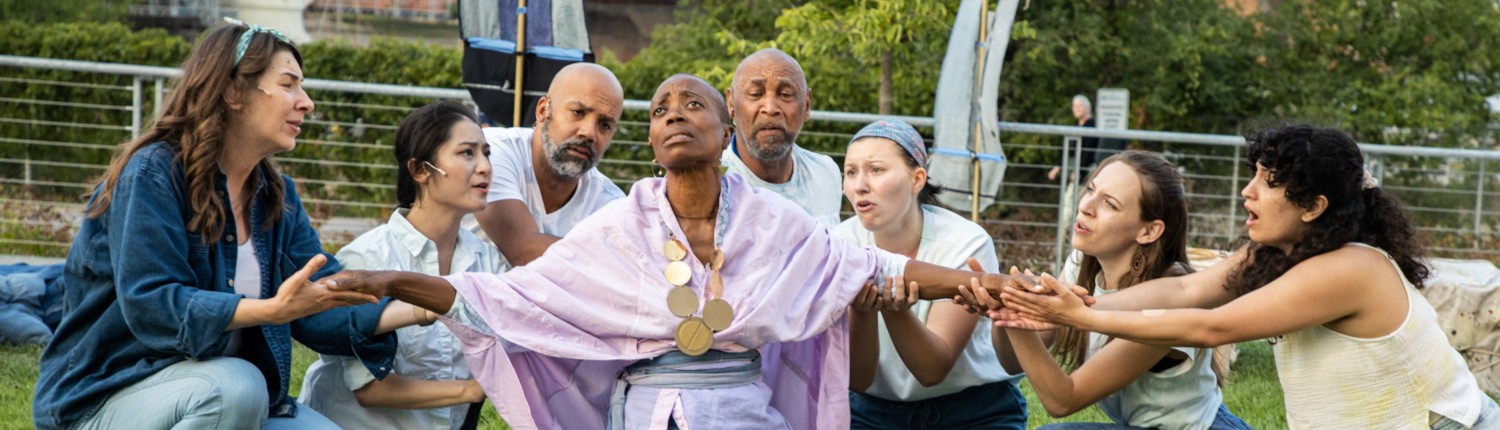
For an Equity member working at Ten Thousand Things Theater in the Twin Cities, there likely comes a moment where the magnitude of the work they're doing hits them, where they have a visceral experience that stays with them long after closing.
For Equity member Karen Wiese-Thompson, one such moment was in a production of Waiting for Godot they brought to a juvenile detention center. As Vladimir, she delivered an emotional monologue reflecting the alienation for which the play is famous. A teenager, about 15, leaned over and grabbed her hand.
"I see you," he told her.
"Here I am, this middle-aged fat white woman, and this Latino boy who would never have crossed paths, having this moment of acknowledging your existence in the world," she recalled.
For Equity member Jason Clusman, a moment came stage managing a production of Iphigenia at Aulis. They were performing at a farm in Wisconsin, and at the climax of the show, the protagonist sacrifices herself and exits the stage, as another actor announces she has transformed into a deer. Right on cue, a deer emerged from the woods.
"None of the actors knew it was happening," he said. "The audience was just in awe."
These moments are possible because of TTT's unique model of theatremaking: in the round, in an area of 15 by 15 feet, at level with the audience, with all the lights on. Performances include a live musician, but almost never amplification.
"It means that actors and audience are literally on the same playing level," said Caitlin Lowans, artistic director of Ten Thousand Things. "We are all equally able to see each other and be seen by each other."
"It's a shock to the system to have somebody just right next to you as you're trying to emote," said Equity member Pedro R. Bayón, who has performed in three TTT productions.
Wiese-Thompson remembers first hearing about TTT's model in the early 2000s.
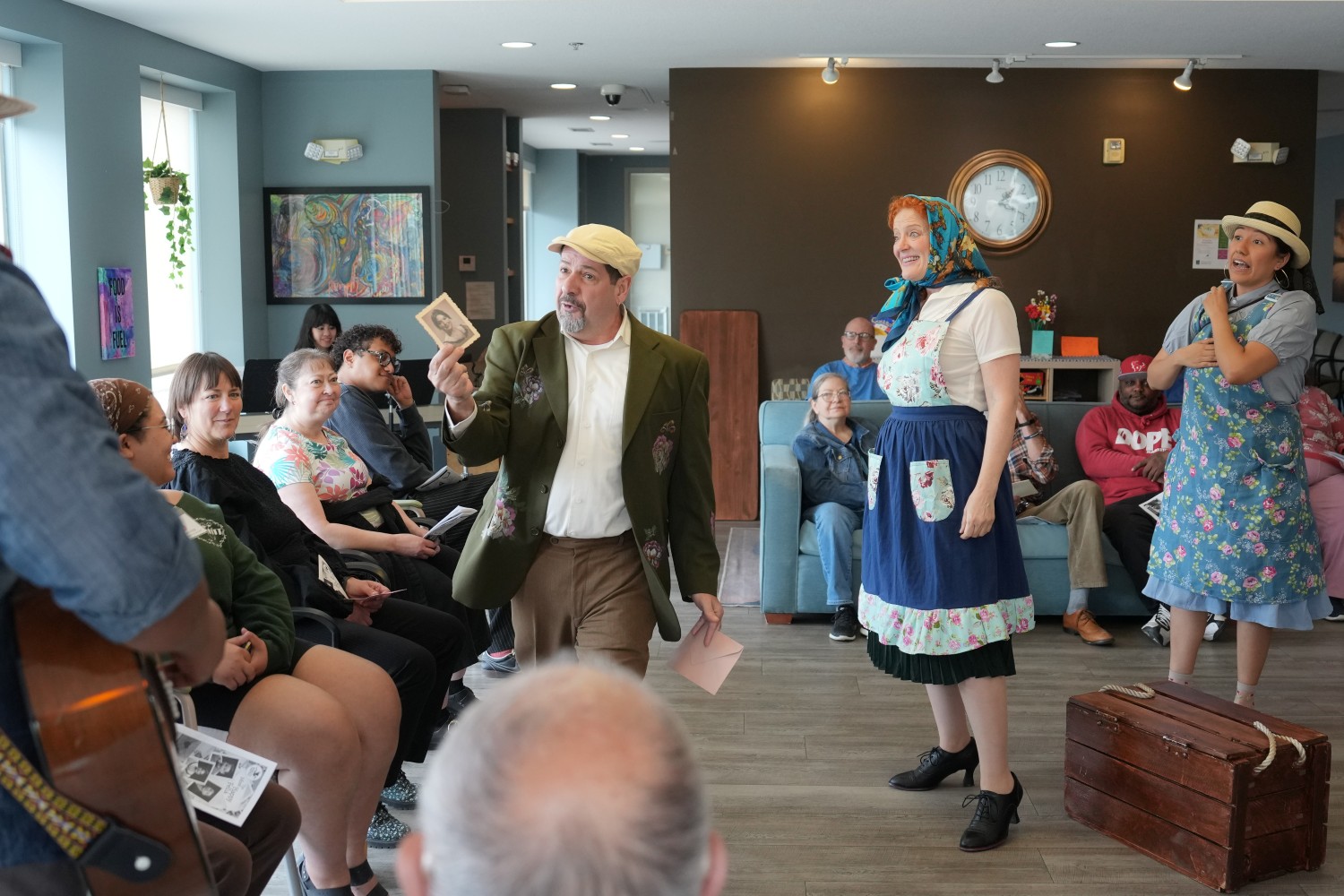
From left: Equity member Pedro R. Bayón, Equity member Norah Long and Julia Diaz in The Most Happy Fella. Photo by Glen Stubbe.
"I thought, 'That sounds horrible!'" she said. But then she got cast there, and she has done more than 20 productions since.
"It changed my life," she said. "It changed how I practice my craft."
"It's so much more based on the human and the storytelling," said Clusman. "It strips away all the big scenic elements, so it's a much more personal experience. I feel much more connected to the actors and the storytelling itself than I do on a lot of other productions I work on, just because that's all you have: You have the actor and your body and you're right there with the audience. I feel that audience response more viscerally because I'm often there helping with a quick change or having to move a prop."
Another crucial aspect to how TTT works is that it travels, and while many of these performances are open to all, half of them are in specific communities for audiences who usually don't have access to theatre, like prisons, shelters and senior homes.
"Sometimes it's in the cafeteria of a local shelter, other times it's in the lobby of a senior living facility," said Clusman, who has worked on five productions at TTT. "Having to be able to step into a space and very quickly make decision that best serves the company and the storytelling is a really fun, interesting challenge."
"It's like Shakespearean folks that would go around to towns," said Equity member Joy Dolo, who has worked both as a performer and director at TTT. "We're like a troupe of actors that go to where a lot of people have never seen a play before."
Ten Thousand Things as a company made its own journey early on: It was founded in 1990 in Los Angeles by theatre artist Michelle Hensley; it moved out to the Twin Cities in 1994. It began its relationship with Equity in 1996, and these days operates on the Small Professional Theatre Agreement.
The theatre’s name is actually a reference to a Taoist framing of the material world. Its staff considers that ironic, since they use so few props and costumes, and also auspicious, because the name came before the theatre settled in the state known as the Land of 10,000 Lakes.
The theatre operates largely on a mix of donations and grants; ticket sales from public performances (pay-what-you-want starting at $15) account for only about a quarter of the budget; affordability is core to the mission.
"In the world today, the arts are so dependent on the generosity of individual givers, and you hear, 'Well, if people want to see theatre so much, they'll pay to see it,'" said Wiese-Thompson. "Well, if that's your gas money you're not going to go see it. People have just as much the right to enjoy the arts as anybody else, despite their income, despite their location, despite their life experiences."
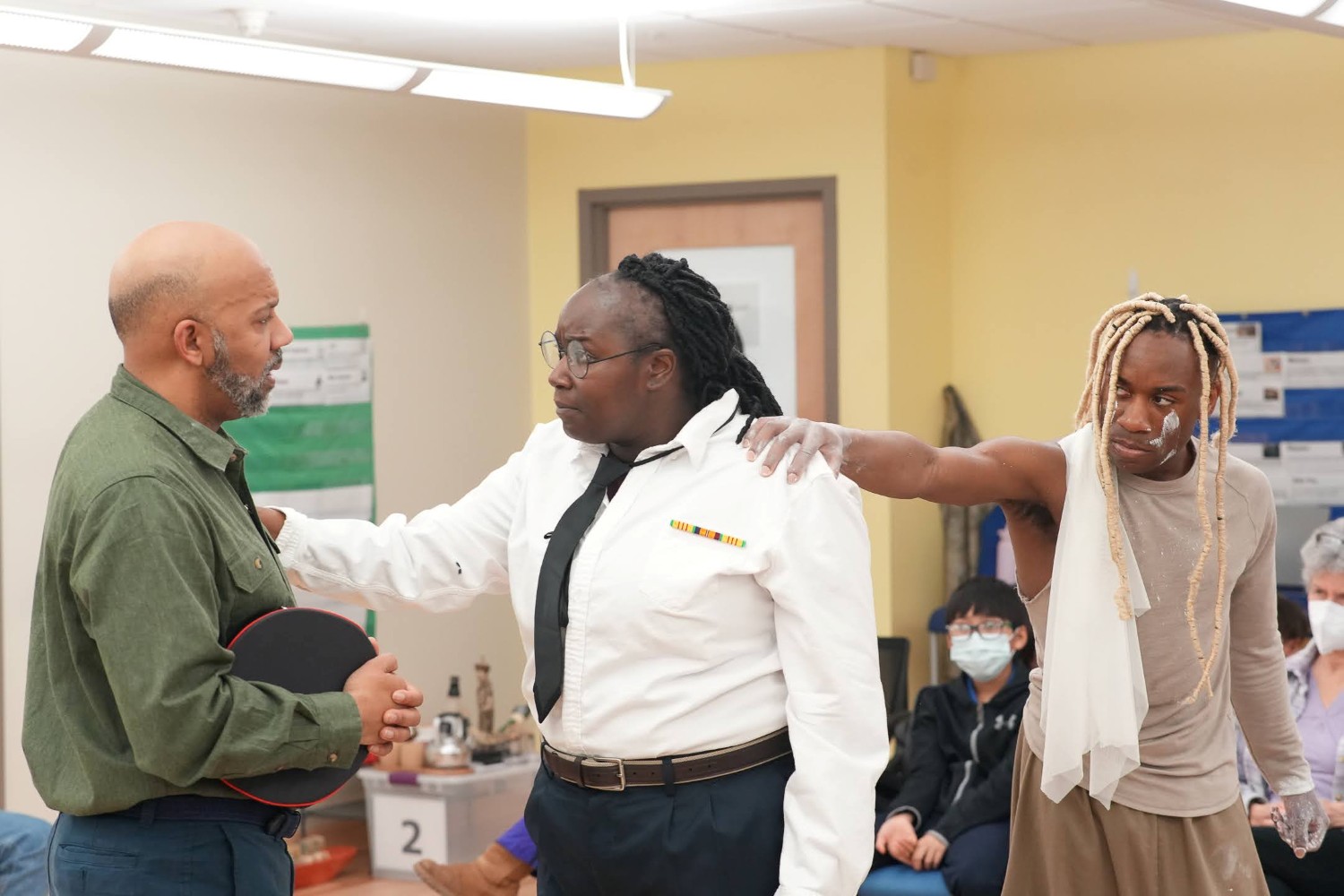
From left: Equity members Will Sturdivant, Joy Dolo and Brian Bose in Mlima's Tale. Photo by Alvan Washington.
Because of the lack of permanent space and minimal sets, props, costumes and lighting, the overhead is minimal, and almost all funds go into labor costs. Equity members said that their pay there is amongst the highest in the Twin Cities.
Beyond compensation, Equity members emphasized that management is respectful of them and their time, always precise about when they are needed at rehearsal and open in communication about scheduling. They even allow artists to bring their children to rehearsal.
"Theatre jobs and jobs in general don't think of the other lives we have outside of the theatre, and it can be easy for theatre world to be all encompassing," said Dolo. "They are always very accommodating to women, to people who have other jobs. It allowed me to be able to bring my best self."
Employers emphasize that supporting artists is part of the theatre's mission statement, which is deeply enmeshed in their relationship with Equity.
"Supporting artists means that we're always looking for ways to show that support: through working conditions, through pay, through the way we set our rehearsal schedule, through the way that we center artists in our leadership and decision-making," said TTT Managing Director Stephanie Thompson. "We're always asking the question: 'How are we serving artists? How can we better be serving artists?’ And part of that includes really being supportive of the unions.'"
"Because our model is so distinct, [Equity gives us] the ability to have a thought partner who is looking out to ensure we're upholding our commitment to artists," said Lowans. "Having a handbook and a group of people who are thinking about how to keep people safe and supported – that keeps people able to do their best work."
TTT currently mounts three productions a year. A production involves 4.5 weeks of rehearsal for an actor (5.5 for a stage manager), followed by 38 performances, 19 of each kind: open to the public, and for specific communities. While venues vary widely (those open to the public range from a community center to an art gallery in a church), audiences are capped at 120 per performance to maintain the intimacy of a piece, which might be 30 people on four sides, no more than three rows deep.
The decision to have minimal objects on stage is artistic, but also practical; many of the spaces TTT visits have strict rules about what they can bring on premises, and some will inspect every item. There can be temporal restraints too; prisons, for example, require that performances last under two hours.
For Equity members on the job, the process is unique from day one. At rehearsals, they try to anticipate what might change along the course of a production. One space might be oblong and another might be square (it makes sightlines complicated); some might be in quieter spaces than others.
"The rehearsal process is always so inventive," said Clusman. "We often start with stuff in the room, but it gets whittled down... it becomes so playful and creative."
TTT has a cult following in the Twin Cities, and public performances often sell out. Equity members find great meaning in every performance, of course, but every one of them said their favorite ones are when they go into communities. For those performances, artists learn quickly to expect the unexpected.
"I love that aspect of not knowing what's going to happen," said Dolo, who has an improv background.
Many Equity members shared stories of audiences interacting with the characters, not just calling out from their seats or asking a question, but getting up onstage, sometimes trying to intervene: attempting to break up a fight, inspecting a character that has died.
"It keeps you on your toes, makes every show a little different," said Wiese-Thompson.
On the other hand, an audience member may at first seem less engaged, folding laundry while watching the show, asking an actor to watch their things while they take a break or walking out in the middle of a performance.
"They might come in and be like, 'That line was funny, and that's what I needed,' and then stand up and leave," said Dolo.
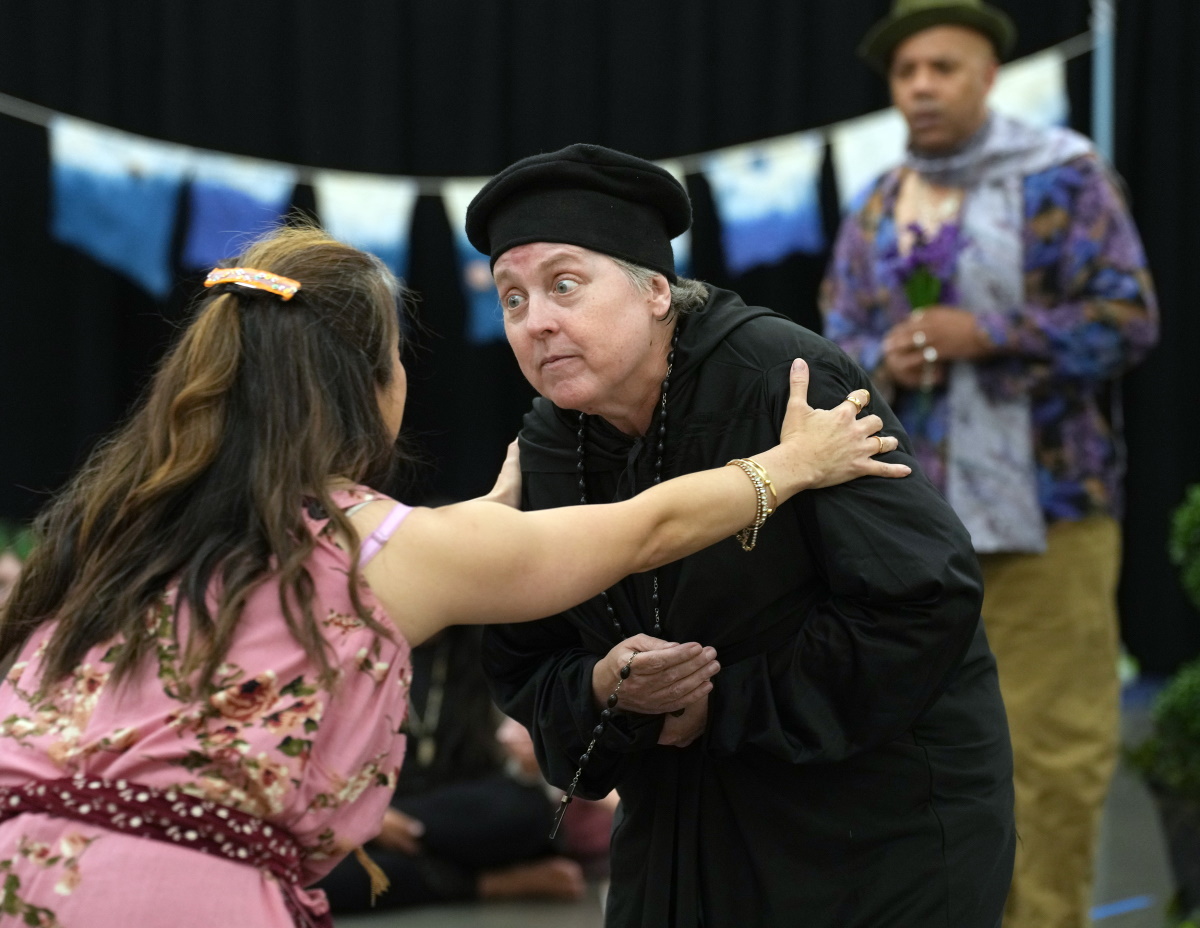
From left: Equity members Katie Bradley, Karen Wiese-Thompson and Will Sturdivant in Twelfth Night. Photo by Tom Wallace.
Equity members have learned to enjoy those moments, too.
"It's made me more tolerant and appreciative of people who have given their time to come watch a performance, but knowing that life just happens," said Wiese-Thompson.
Equity members reported feeling the impact of these performances in real time.
"Our first performance of [The Unsinkable Molly Brown] on tour was a private show at a correctional facility," said Equity member Max Wojtanowicz. "I thought I knew what I was in for... but I could not have anticipated the impact it would have on me to walk into that space and setting up to do the play at this gym in a correctional facility for a group of male inmates, and watch them walk in and not know what we're going to do.
"What are we doing here? Why are we doing this Broadway musical?" Wojtanowicz remembered asking himself. "They are going to think were pandering to them, that we don't understand their experience."
The musical opens with young Molly swearing that she will never give up: "I Ain't Down Yet."
"The way those men leaned in, many of whom had never seen theatre before, felt that story at the top of their skin as so thrilling, and it suddenly felt like we were so together," said Wojtanowicz. "There was no line between audience and artists. There was no line between haves and have-nots. There was no line between the incarcerated and the free... We looked at them and saw the humanity they possess."
This level of high emotional stakes and close level of contract keeps Equity artists on the top of their game.
"You're always as an actor trying to play the truths of the scene and the character, but in Ten Thousand Things you have to do that even more," said Equity member Katie Bradley. "You don't have lights and all the other design enhancements to hide anything."
Or as Wiese-Thompson put it: "A person who's sitting in a prison for ten years doesn't buy into your bullshit if you're faking it. They're going to see it and call you on it in front of everybody."
For locals across life circumstances, the Twin Cities have been through turbulent times, from the murder of George Floyd to Operation Metro Surge. For the latter, which was recent, members who were on contract at TTT reflected on how safe the theatre felt for them, even when rehearsing close to some of the worst violence, including where Renée Good was murdered. There were days the artists were escorted to and from their cars.
"The company always wants to take care of its artists," said Clusman, who was stage managing Men on Boats during Metro Surge. "As a company, we all kind of came together and decided that we needed each other in that room, to have that escape but also that shared experience in support of each other instead of being isolated in our individual homes. We had support of each other, but also Ten Thousand Things as a larger company was incredibly supportive and respectful throughout that process. So it was really reassuring."
When Equity members go on to jobs at other theatres after working at TTT, they find they have changed as artists.
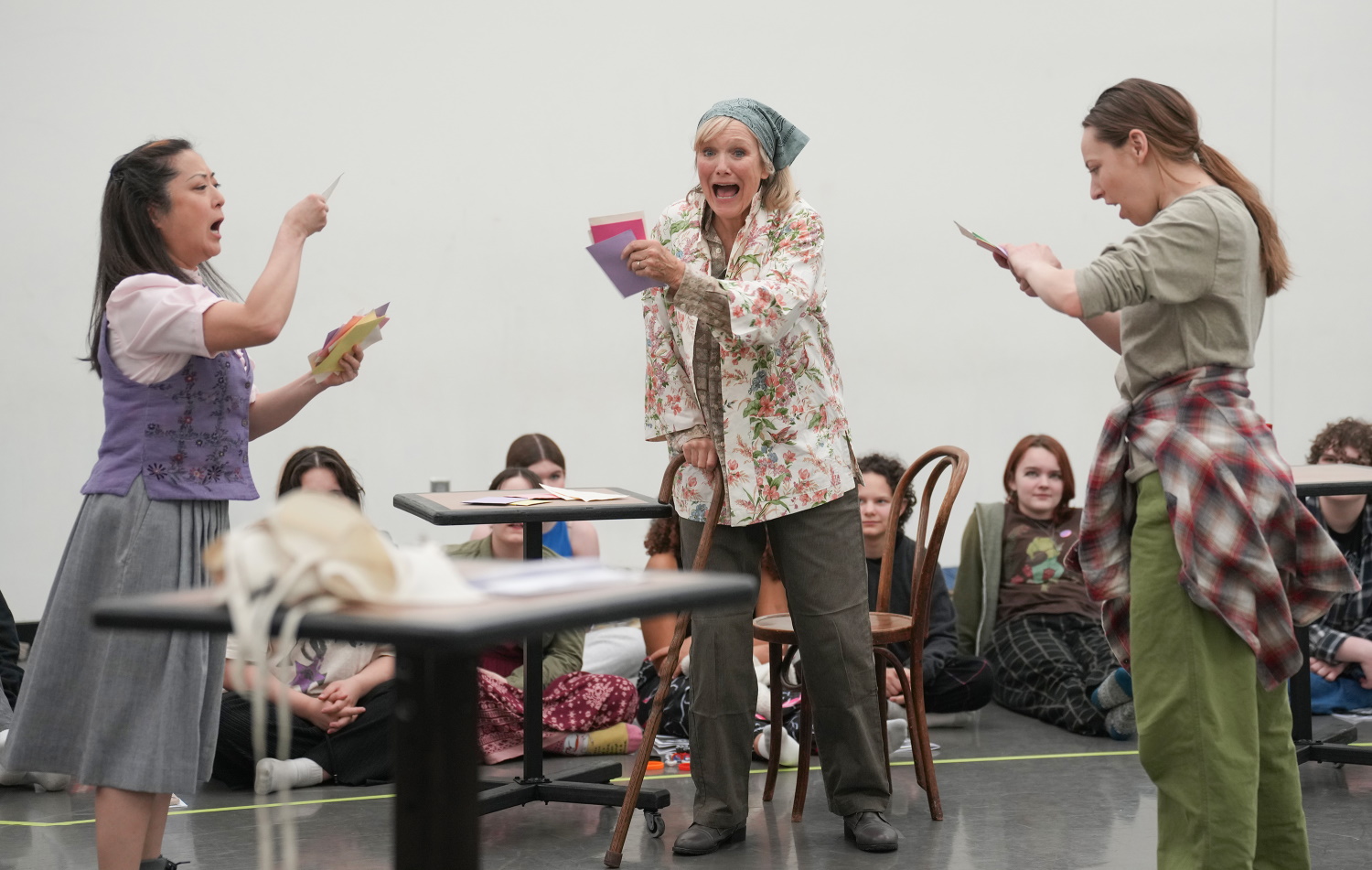
From left: Equity members Katie Bradley, Michelle Barber and Katherine Fried in The Spitfire Grill. Photo by Tom Wallace.
"I've used so many of the skills that I have honed with Ten Thousand Things in other theatre situations," said Bradley, who in addition to acting in seven productions at TTT has also done paid work going into community spaces before a performance to prepare the audience on what to expect, tell them about the show and its themes. "My own flexibility as an artist has been completely changed because of Ten Thousand Things and how flexible you have to be."
"You never forget that an audience is there and that we're engaging them and opening up their minds and allowing the company and the audience to be completely creative," said Clusman. "I think that only makes stronger actors, stage managers, directors around the Twin Cities and nationally... These people then go out into the bigger community and can take that experience to bigger companies."
Equity members spoke of the important place TTT holds in the Twin Cities, one of the most vibrant theatre markets in the country.
"The way Twin Cities artists feel about this theatre is: This is the one theatre we cannot lose," said Wojtanowicz. "And luckily, it's the one that has the least overhead.
"Every actor in town wants to work at Ten Thousand Things,' he said. "It's just one of those places that has such a thrilling mission statement in a way that so many theatres strive for, to have that clarity of focus in what they do and who they serve."
"In terms of quality, they're probably one of the highest in the Twin Cities in terms of the talent they get: stage managers, designers, actors," said Wiese-Thompson. "It's all really rock solid."
Members believe this model could work anywhere, and some dream of bringing it beyond the Midwest. Bayón, for one, would love to do that sort of work in Puerto Rico.
"Every city should have a group like them," he said. "It's my favorite way of telling a story."
Ultimately, Equity members who work at TTT say after they have worked there, they can't wait to come back.
"I'm so addicted to this high," said Wojtanowicz. "I know actors who don't want to work anywhere else."
Banner image from left: Equity member Elizabeth Reese, Equity member Stephanie Anne Bertumen, Equity member Will Sturdivant, Equity member Regina Marie Williams, Equity member Joe Nathan Thomas, Hailey "Sky" Turiello, Equity member Katherine Fried and Equity member Janely Rodriguez in Iphigenia at Aulis. Photo by Alvan Washington.